
כח אַל-תַּסֵּג, גְּבוּל עוֹלָם– אֲשֶׁר עָשׂוּ אֲבוֹתֶיךָ. |
28 Remove not the ancient landmark, which thy fathers have set. |
Proverbs – מִשְׁלֵי
I love to go to museums. Art, history, architecture, objets d’art, furniture, you name it. Certainly, I look at many things through the prism of the relations to Jews and Judaism. What’s better than to visit a place I was thinking about for a long time, but never got around to go?
I am talking about the museum/synagogue of Eldridge Street.
Everybody knows that at some point in history, New York’s Lower East Side was home to more Jews than any other place in the world. It was also the most crowded place in America to live with thousands of poor people, mainly Jews, and Italians cramped into the tenements – tiny apartments – “these humble, multiple family buildings were the first American homes for thousands of immigrants.” These were the people, who like Abraham Gamberg, a Ukranian Jewish immigrant thought that in America “all you have to do is get a big shovel and a sack and you go out in the street and shovel the gold into the sack”. There wasn’t much gold around those dirty buildings, but plenty of hope.
The Jewish population of New York started with a few Sephardi Jews that then governor Peter Stuyvesant was not too willing to count among the city residents. Ashkenazi Jews, not counting a few families preceding the Sephardim, started to trickle to New York in the mid-eighteenth century, running away from Germany, the Russian Empire, and other European countries, where their treatment was less than pleasant.
“By 1800, New York City’s Jewish population numbered around four hundred people,” says the author of “The synagogues of New York’s Lower east Side“, Gerald R.Wolfe. At this point, the only synagogue existing in New York City was Shearit Yisrael, where the Sepharadi minchagim were observed. Later on, Ashkenazi synagogues were built, but the shul on Eldridge Street became the first synagogue built by Eastern European Jews. By the time the building was commissioned in 1886, the Kahal Adath Jeshurun already existed in a different location. 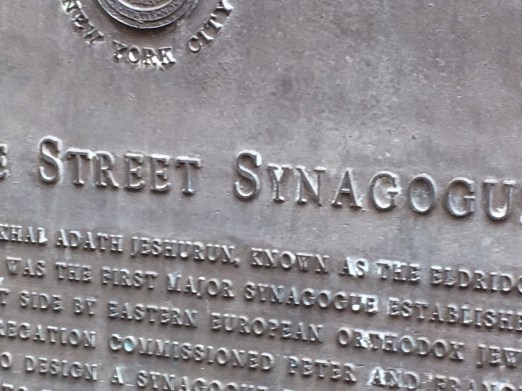 In 1886, the members bought the adjacent lots on 12, 14, and 16 Eldridge Street and hired German architect brothers to finish the project. The first High Holiday Service served as the opening of the shul in the fall of 1887 with the famous cantor Pinhas Minkowsky from Odessa, who was lured by the offer of first-class transit to New York City with his family, as well as a contract for $2,500 a year! This was the time when the average salary for a worker was $450 a year. After the mandatory five years, though, the cantor returned to Odessa. His short biography does not even mention the famous synagogue in New York. Interestingly enough, 1887 was also the year that New York had officially tried to obtain its first and only Chief Rabbi of the country. Prior to this time, the kashrut business was not really established, and “the butchers, slaughterers, and other food purveyors” had “a relatively free hand to sell whatever they wanted and call it “kosher”. This disorder caused a number of traditional New York congregations in 1887 to form the Association of American Orthodox Hebrew Congregations. The Association imported Rabbi Jacob Joseph from Vilna to be America’s “Chief Rabbi”, writes Hasia Diner in her research work on food traditions of immigrant communities in the United States.
Another interesting thing for me was the fact that one can easily recognize German, or maybe, Catholic architectural influences 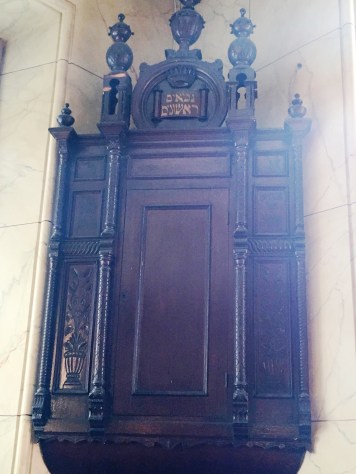 inside the building that is, mostly, of a beautiful Moorish Style.
I am not a good photographer at all, and the sanctuary is, unfortunately undergoing some work, so it’s hard to get a picture from the right angle, but you can see a distinctly crafted wooden closet of which they have two – one on each side of the Aron ha-kodesh. These are used to house the books of Haftarah and are named “for Neviim“. They look very much like similar “closets” that can be seen in many churches, of which I am not an expert at all. Talk about the inter-influence of styles and fashions! Or, possibly, this was just what the German architects were familiar with.
The Aron ha–kodesh itself has a fascinating story that was related to us by the docent running the tour. Apparently, when the whole synagogue was dilapidated after the closure of the main sanctuary in the 1950s due to the fact that with the loss of members the shul could no longer sustain itself and pay for utilities, the only place that stayed “like new” was Aron ha–kodesh.


The docent told us that in 1971, when Gerald Wolfe came into the shul, and together with synagogue staff opened the sanctuary, they found a horrible sight “chunks of ceiling, pieces of wall, and balusters … Eerie sounds were made by scores of cooing pigeons as they fluttered and huddled in the overhead rafters” (G.Wolfe)
The only place that seemed untouched was the Torah ark – Aaron ha-kodesh! It is huge and has space for many sifrei Torah. Evidently, it was constructed to preserve the precious scrolls with such attention that it was not penetrated by the elements, even though everything around it was pretty much destroyed. When you open it and stick your hand inside, you feel a nice coolness to your hand. Even the velvet inside is original.
The restoration project took place from 1976 to 2007 as opposed to less than two years to build in the 1880s. It also cost almost twenty million dollars unlike the original 92 thousand. The result, though, is magnificent. It gives you a glimpse into the life of New York Jewry of the days gone by. Never again (or should I say maybe) Jews will be hurrying down the narrow streets selling their wages, Jewish women protesting high prices of kosher meat, and socialists running up and down the original Forwards building, where residents of today have no idea that their luxury condominium is adorned with the bas-relief of Karl Marx himself.
Today, the shul functions as a museum with interactive activities to explain what the bimah is, what the tallit is for the curious.


In the lobby, the beautiful old postcards present the world of eastern European Jewish life that will no longer return to Poland, Hungary, 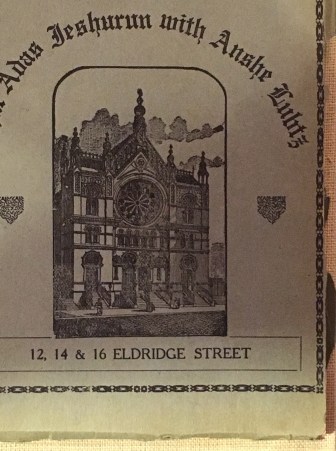 Russia.
Congregation Adath Yeshurun can hardly gather a minyan for Shabbat, the only day when the shul reverts to its original purpose.


The women’s gallery, where the best view of the shul opens to your eyes is never going to hear the swooshing sounds of long beautiful dresses of women sitting in the numbered seats.
Jewish life is fluid, and I am not sure if I should look at the Lower East Side, now totally Chinese as a bad or good omen. Times are changing, and more of us are moving closer to our families whether in the States or in the State of Israel. One day, hopefully, I will exchange the goldine medina for the Holy city as well.


 Noshing Across the Nation
Leave a comment